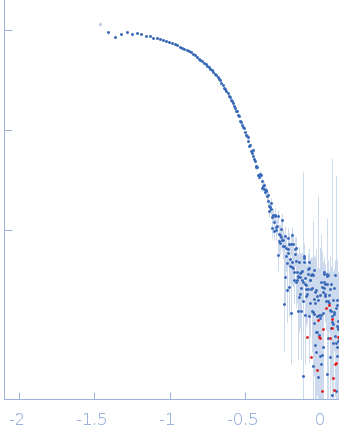
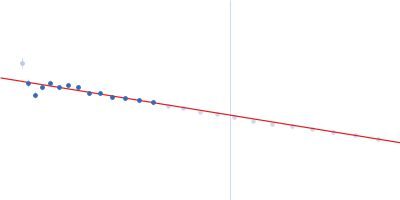
Thermo Fisher polystyrene nanospheres with a diameter of 20 nm查看序列
(C8H8)N
othersynthetic construct
——–—
monomer分子数 1
1.0 kDa
实验曲线
曲线
点数 / 列
q 范围
误差质量
负强度点
来源文件
1
300[3]
0.03455013–1.325521 1/nm
含误差列缺失 0
21
sasbdb/entries/d4/sasdwd4/source/SASDWD4.dat
▼
2. SASBDB 报告的指标 Reported Results
指标
方法
数值
误差
单位
dmax
P(r)
25.0
—
nm
i0
Guinier
5459.64
—
arbitrary
i0
P(r)
5214.0
—
arbitrary
rg
Guinier
9.0
0.515
nm
rg
P(r)
8.593
—
nm
这些数值是 SASBDB 来源记录,不是 SAXSdb 对实验曲线重新计算的结果。
▼
3. 来源拟合与模型 Source Fits & Models
该条目没有来源拟合记录。
▶
4. 来源文件索引 Source Files
类别
路径
下载状态
大小
curve
sasbdb/entries/d4/sasdwd4/source/SASDWD4.dat
downloaded
21037
full_entry_zip
sasbdb/entries/d4/sasdwd4/source/SASDWD4.zip
downloaded
12162
pddf
sasbdb/entries/d4/sasdwd4/source/SASDWD4.out
downloaded
22573
sascif
sasbdb/entries/d4/sasdwd4/source/SASDWD4.sascif
not_available
—
summary
sasbdb/entries/d4/sasdwd4/source/summary.json
downloaded
6566
▶
5. 实验说明与论文 Experiment & Publication
实验说明原文
Synchrotron SAXS data from solutions of 20 nm polystyrene beads separated using asymmetric flow field flow fractionation (AF4) in water/detergent solution (0.0125 % (v/v) NovaChem), pH 7 were collected on the EMBL P12 beam line at PETRA III (DESY; Hamburg, Germany) using a Pilatus 6M detector at a sample-detector distance of 6 m and at a wavelength of λ = 0.12 nm (I(s) vs s, where s = 4πsinθ/λ, and 2θ is the scattering angle). AF4 separation was performed at 20°C using a detector flow rate of 0.5 mL/min with a starting cross flow rate of 2 mL/min with an exponential decay. 300 µL of a polystyrene bead mixture (0.44% PS 20 nm + 1.1 % PS 100 nm) were injected. 2100 successive 1 second SAXS data frames were collected through the entire AF4 elution (35 min), where 30 sample data frames were selected through the second elution peak corresponding to the PS 20 nm fraction. The data were normalized to the intensity of the transmitted beam and radially averaged; the scattering of the solvent-blank was subtracted.
相关论文
标题
AF4-to-SAXS: expanded characterization of nanoparticles and proteins at the P12 BioSAXS beamline.
European Molecular Biology Laboratory (EMBL) - Hamburg outstation
experiment.contributor[0].affiliation[0].webpage
http://www.embl-hamburg.de/index.php
experiment.contributor[0].contributor_name
Melissa
experiment.contributor[0].contributor_surname
Graewert
experiment.contributor[0].orcid
null
experiment.concentration_method
null
experiment.concentration_unit
null
experiment.date
2023-06-19
experiment.storage_temperature
20.0
experiment.cell_temperature
20.0
experiment.exposure_time
1.0
experiment.number_of_frames
2100
experiment.wavelength
0.12
experiment.sample_detector_distance
6.0
experiment.concentration_min
null
experiment.concentration_max
null
experiment.sample_volume
null
experiment.flow_rate
null
experiment.s_min
0.035
experiment.s_max
1.326
experiment.total_exposure_time
null
experiment.seccolumn
null
fits
[]
estimated_volume_method
null
pddf_software
ATSAS GNOM
pddf_software_version
null
i0_calibration_standard
null
description
Note. The expected MW calculated from the from the atomic composition of the beads is unknown.
experiment_description
Synchrotron SAXS data from solutions of 20 nm polystyrene beads separated using asymmetric flow field flow fractionation (AF4) in water/detergent solution (0.0125 % (v/v) NovaChem), pH 7 were collected on the EMBL P12 beam line at PETRA III (DESY; Hamburg, Germany) using a Pilatus 6M detector at a sample-detector distance of 6 m and at a wavelength of λ = 0.12 nm (I(s) vs s, where s = 4πsinθ/λ, and 2θ is the scattering angle). AF4 separation was performed at 20°C using a detector flow rate of 0.5 mL/min with a starting cross flow rate of 2 mL/min with an exponential decay. 300 µL of a polystyrene bead mixture (0.44% PS 20 nm + 1.1 % PS 100 nm) were injected. 2100 successive 1 second SAXS data frames were collected through the entire AF4 elution (35 min), where 30 sample data frames were selected through the second elution peak corresponding to the PS 20 nm fraction. The data were normalized to the intensity of the transmitted beam and radially averaged; the scattering of the solvent-blank was subtracted.